Team
Sheridan College's Spring 2025 Design week
Tools
Unity, Asprite, Miro
Team
Sheridan College's Spring 2025 Design week
Tools
Unity, Asprite, Miro
Team
Sheridan College's Spring 2025 Design week
Tools
Unity, Asprite, Miro
KEY POINTS
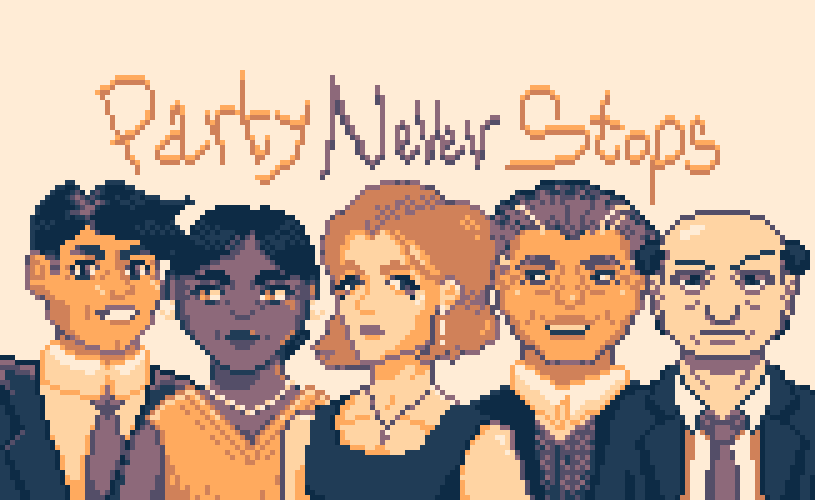
Developed design documentation for the primary puzzle by creating an early diagram with detailed notes.
Led asset creation and helped guide less experienced secondary artist.
Created a majority of the character art in conjunction with the narrative designer.
KEY POINTS
Developed design documentation for the primary puzzle by creating an early diagram with detailed notes.
Led asset creation and helped guide less experienced secondary artist.
Created a majority of the character art in conjunction with the narrative designer.
KEY POINTS
Developed design documentation for the primary puzzle by creating an early diagram with detailed notes.
Led asset creation and helped guide less experienced secondary artist.
Created a majority of the character art in conjunction with the narrative designer.
OVERVIEW
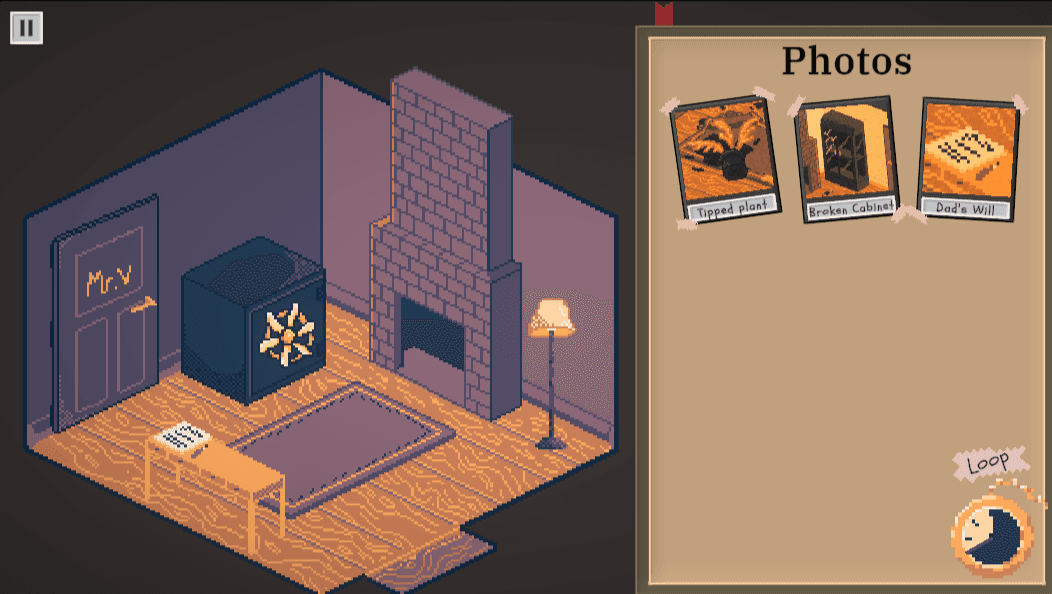
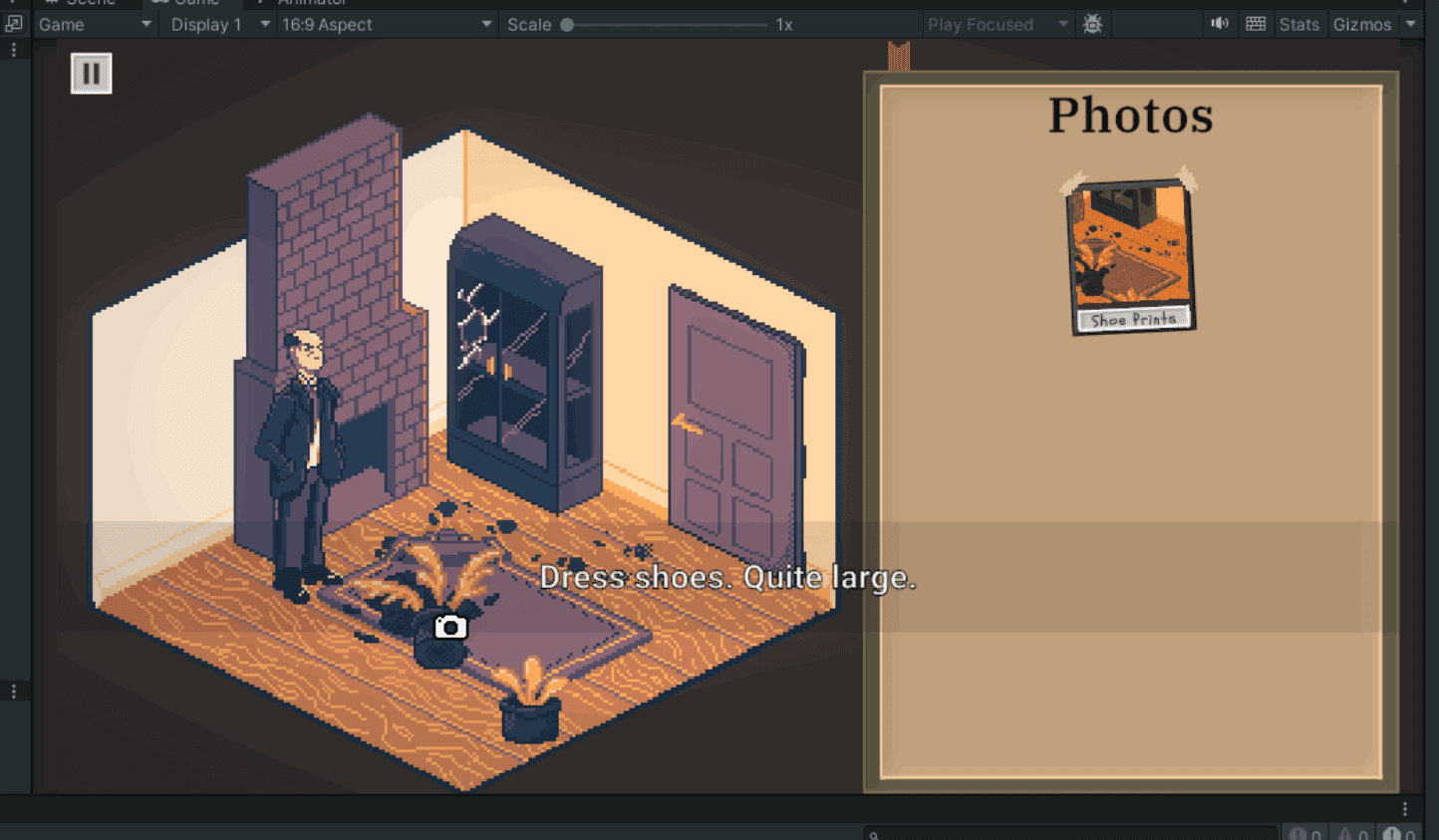
Built as part of a program-wide game jam (called “design week”) at Sheridan College. Party Never Stops is a time-loop point-and-click mystery game about trying to prevent your father’s murder. Each time you fail, the time loop starts again!
OVERVIEW
Built as part of a program-wide game jam (called “design week”) at Sheridan College. Party Never Stops is a time-loop point-and-click mystery game about trying to prevent your father’s murder. Each time you fail, the time loop starts again!
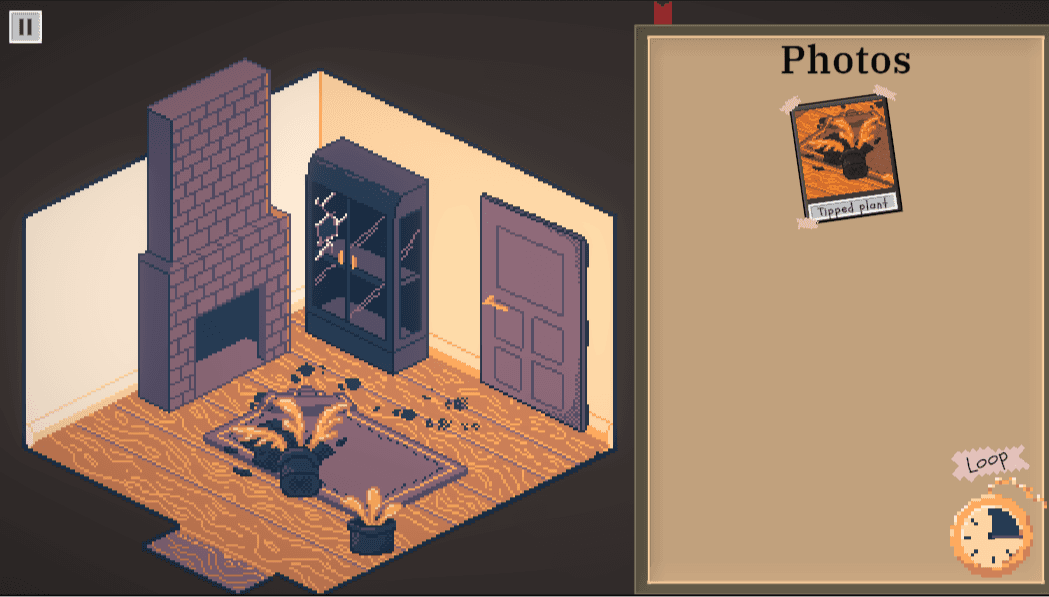
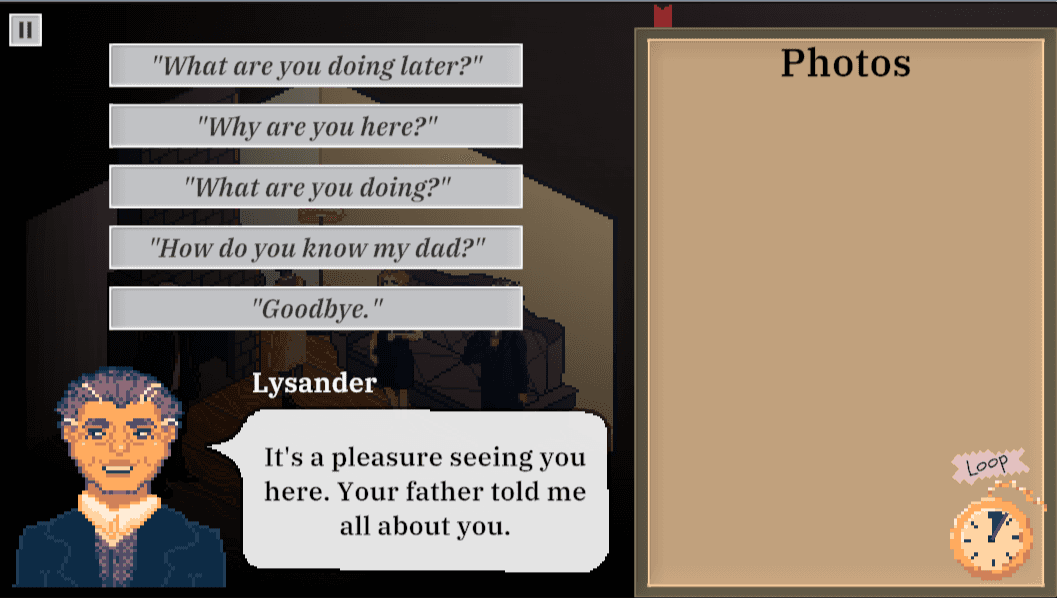
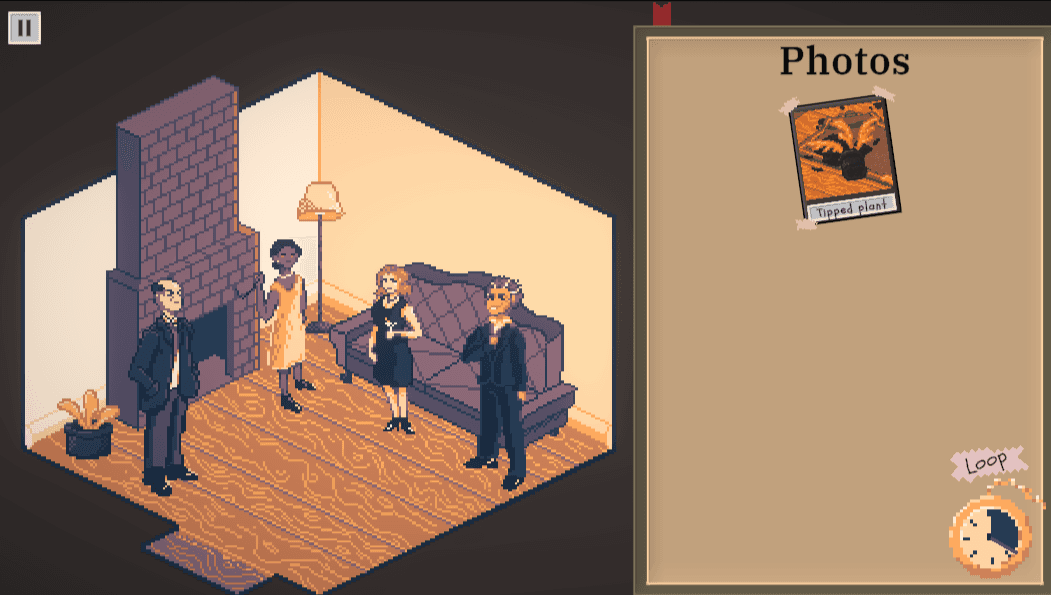
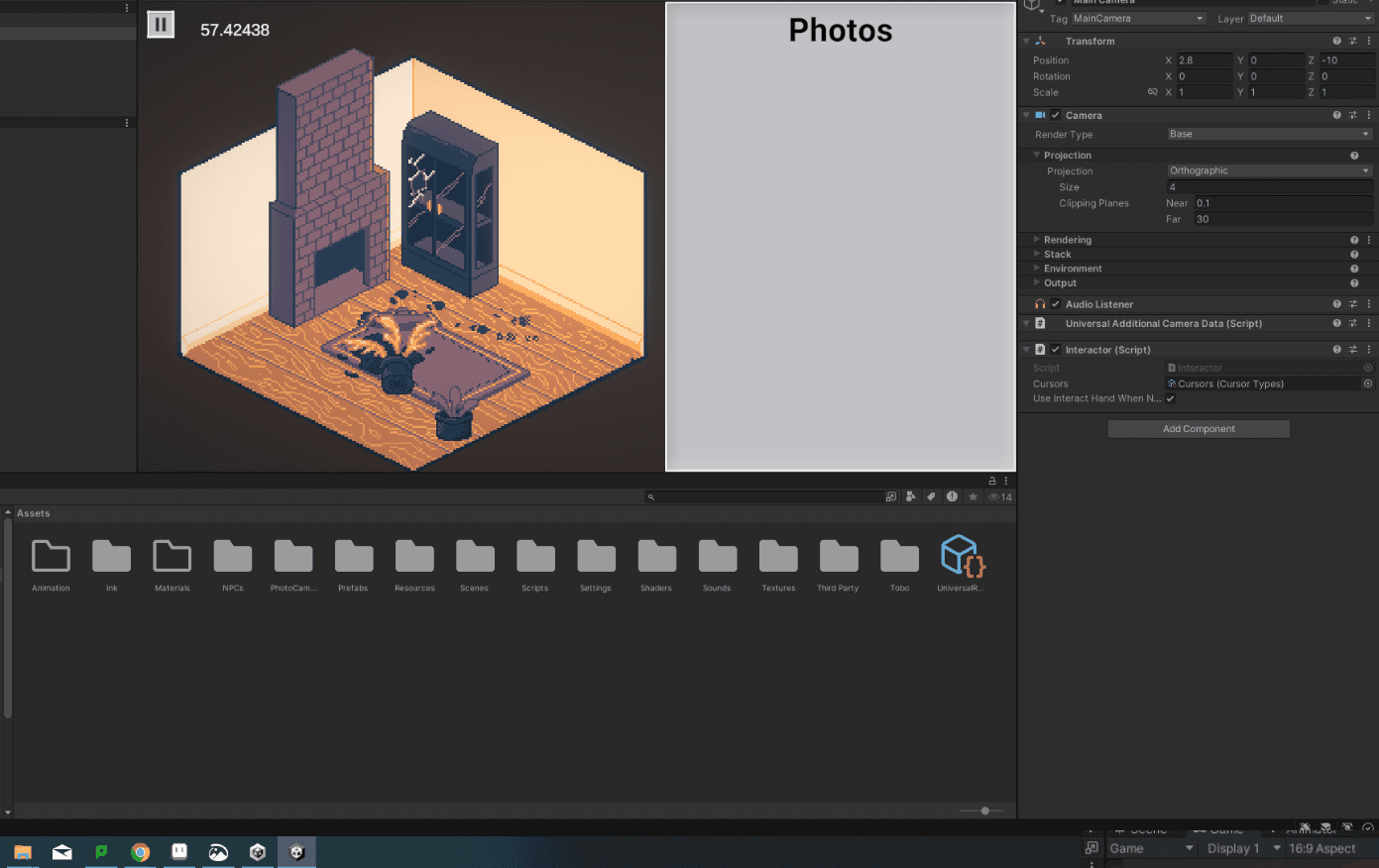
Above, see some screenshots from the finished game showing its functionality.
DESIGN PROCESS
The objective for this year's design week was to create a short, 3 puzzle game with the inclusion of a physical component. This left lots of room for lots of interesting ideas, but ultimately caused us to get a little lost in the possibilities.
DESIGN PROCESS
The objective for this year's design week was to create a short, 3 puzzle game with the inclusion of a physical component. This left lots of room for lots of interesting ideas, but ultimately caused us to get a little lost in the possibilities.
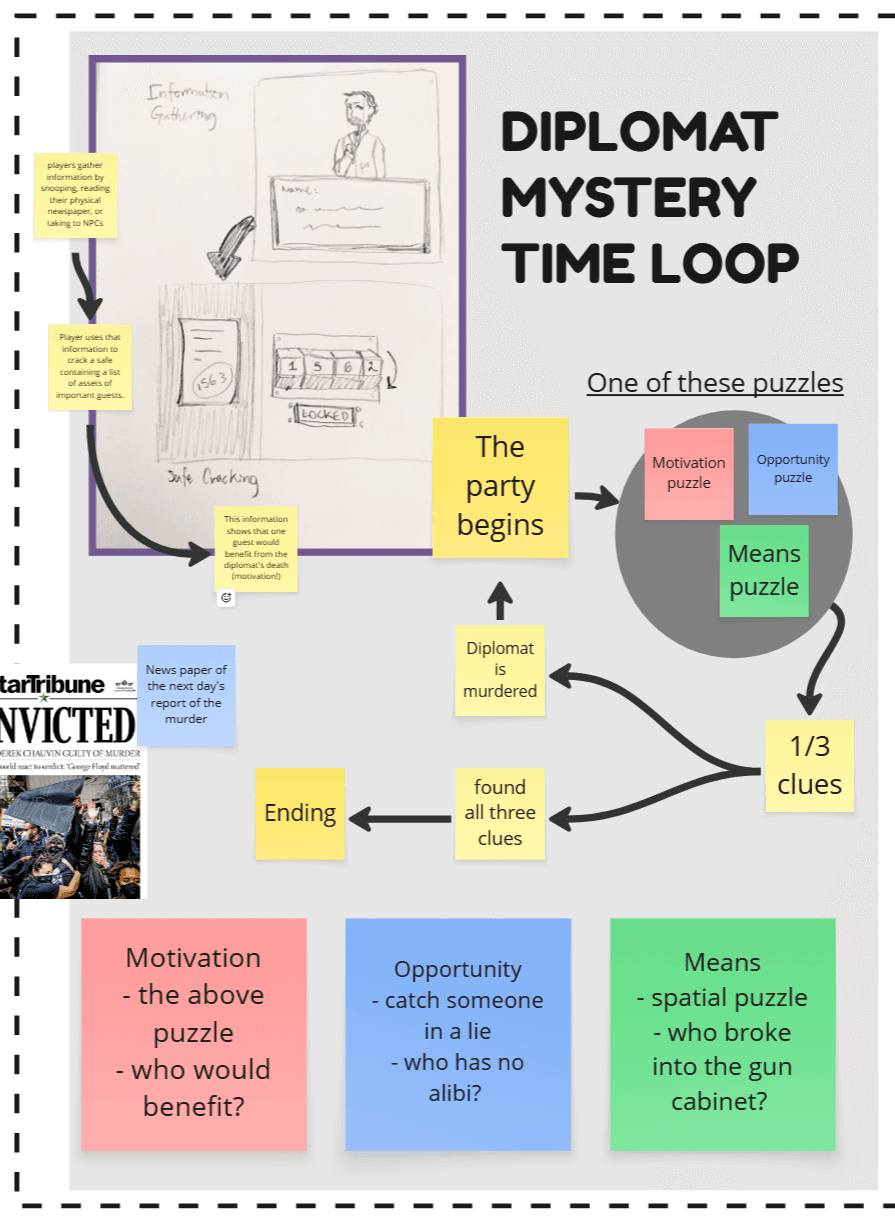
Here was my original pitch for the core loop of Party Never Stops, and the idea we decided to stick with. I decided to take advantage of the classic puzzle board-game Clue to create the three primary puzzle pieces the player needed to solve: Motive, Means, and Opportunity. While not revolutionary by themselves, the three puzzle pieces I proposed gave the game structure and clear goals that the player was likely to be familiar with already.
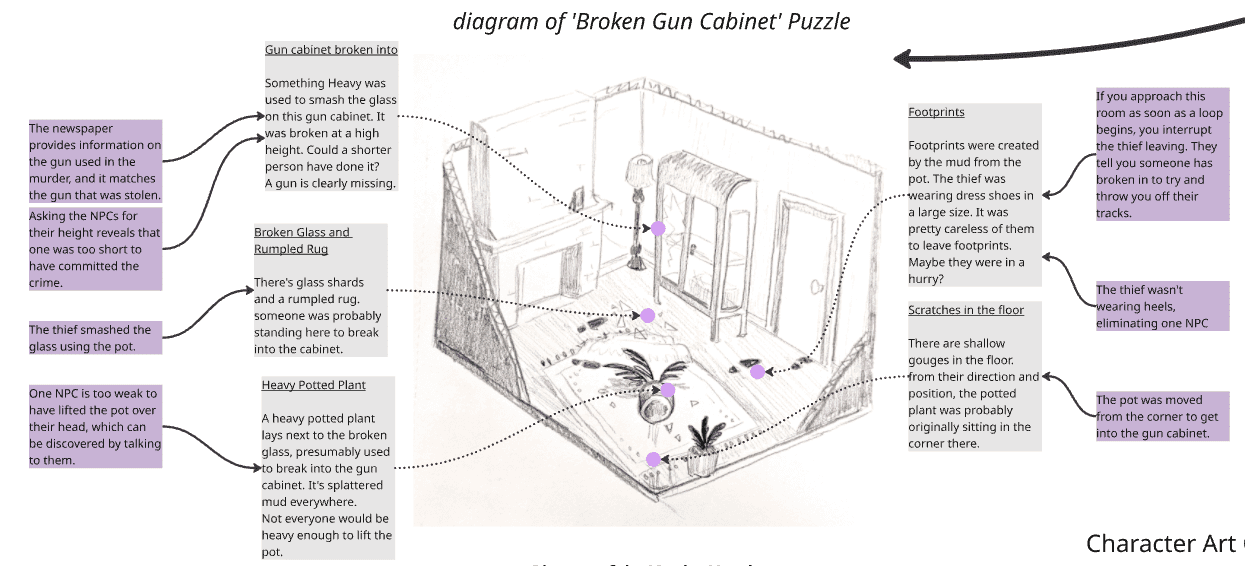
As the project developed and our direction became more clear, I created this simple one page design for the first (and primary) puzzle. I took advantage of my time spent reading mystery novels to develop a puzzle that encouraged the player to use inductive and deductive reasoning. For example, the player might notice that the potted plant was very heavy, that not everyone could lift such a heavy plant, and come to the conclusion that only a person who could lift the heavy plant could've broken into the gun cabinet (in the case of inductive reasoning).
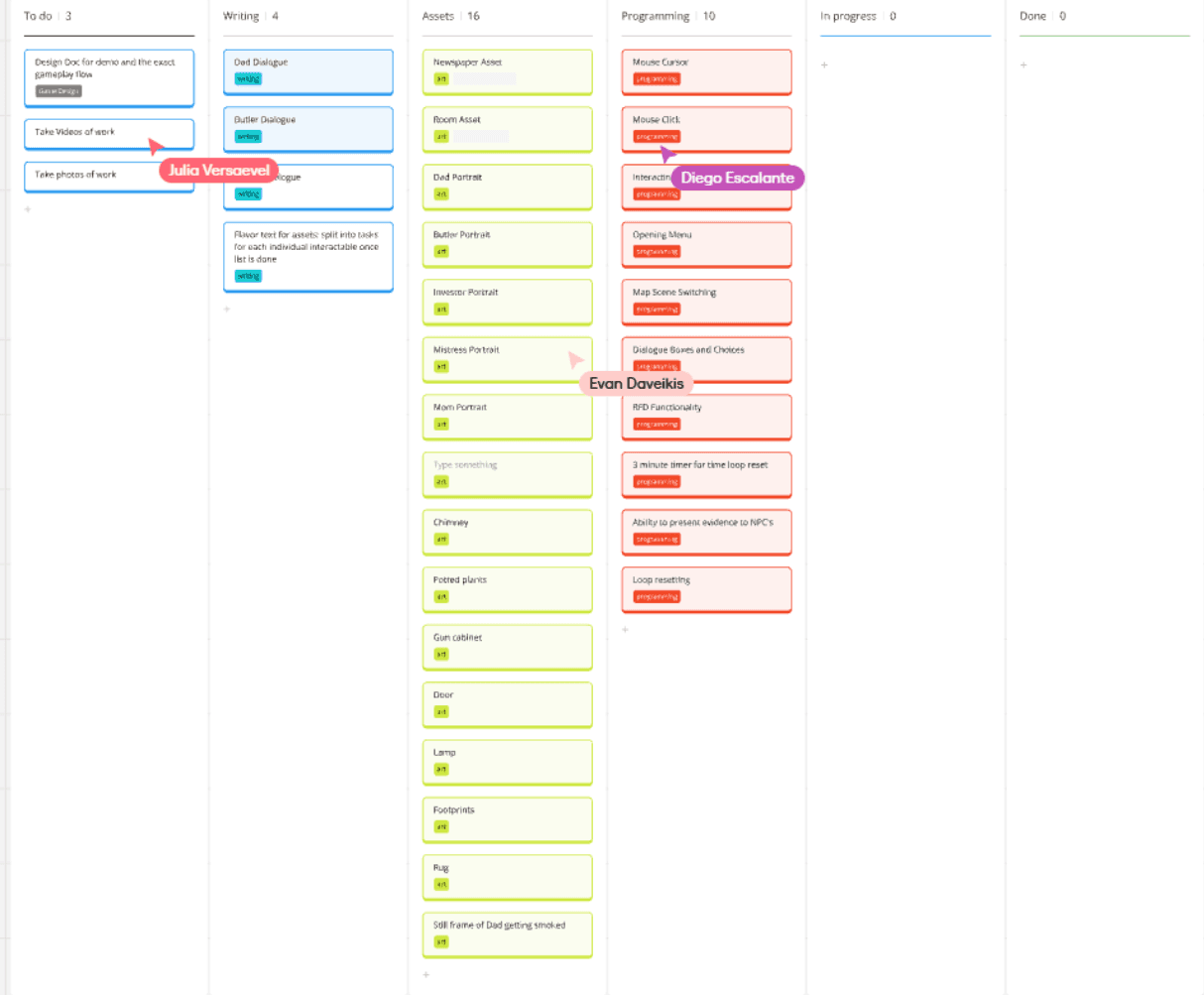
We were successfully able to create a rapid prototype of our game in a short period of time because we very carefully managed tasks and paid attention to the requirements for a MVP (minimum viable product). As a leading artist, this approach made my work much easier and helped me to develop a streamlined process for the assets we needed to make.
LEARNINGS
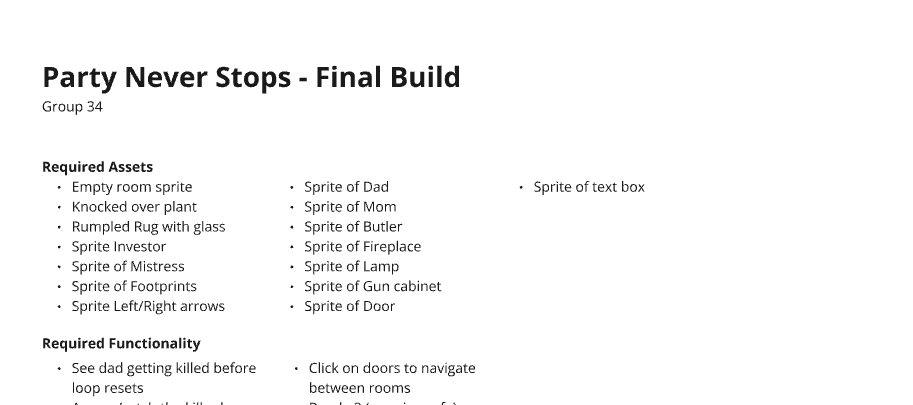
For Party Never Stops, our team created specific and detailed documentation on what was otherwise a rather small project. This was hugely useful in keeping the team organized, and allowed us to squeeze as much as possible out of the time we had. I learned how valuable good documentation was, regardless of project size. For later projects, I've taken this lesson to heart and now always keep my documentation up-to-date and relevent.
LEARNINGS
For Party Never Stops, our team created specific and detailed documentation on what was otherwise a rather small project. This was hugely useful in keeping the team organized, and allowed us to squeeze as much as possible out of the time we had. I learned how valuable good documentation was, regardless of project size. For later projects, I've taken this lesson to heart and now always keep my documentation up-to-date and relevent.
LEARN-INGS
For Party Never Stops, our team created specific and detailed documentation on what was otherwise a rather small project. This was hugely useful in keeping the team organized, and allowed us to squeeze as much as possible out of the time we had. I learned how valuable good documentation was, regardless of project size. For later projects, I've taken this lesson to heart and now always keep my documentation up-to-date and relevent.